
Food Wrapping Paper Cutting: 6 Checks Before Production
Inconsistent sheet lengths, wrinkled paper and uneven stacks rarely come from speed alone. These six checks help converters prepare roll-to-sheet production and agree on a meaningful material trial.
Inconsistent sheet lengths, wrinkled paper and uneven stacks can turn a straightforward cutting job into repeated stops and rejected output. With hamburger wrapping paper, greaseproof paper and PE-coated grades, the first question is not simply how fast the machine runs — it is whether the material, cutting setup and delivery system work together.
Food wrapping paper cutting: essential checks
| Check | Warning sign | What to verify before production |
|---|---|---|
| Material and coating | Unexpected curl, residue or handling changes | Paper grade, grammage, coating structure and representative samples |
| Unwinding and guidance | Wrinkles, drifting edges or unstable feeding | Roll condition, tension control and web alignment |
| Blades and cut edges | Fraying, dust or incomplete cuts | Blade condition, cleanliness and manufacturer-approved setup |
| Dimensions and registration | Length variation, skew or misplaced artwork | Size tolerance, squareness and print-position requirements |
| Separation and stacking | Clinging sheets, floating edges or uneven piles | Static, curl, delivery settings and stack acceptance |
| Usable output | High indicated speed but frequent stops | Accepted sheets, rejects and interruptions during a representative trial |
Six checks that separate a reliable food wrapping paper run from a trial-and-error setup.
1. Identify the Substrate and Coating
Start with the actual material specification, not a broad label such as “burger paper.” Greaseproof paper is not necessarily PE-coated, and grease resistance does not automatically mean moisture resistance. Paper-plastic composites may also behave differently from uncoated grades.
Confirm the coating type, which side is coated, and the roll width, diameter and core size. For coated or laminated grades, provide both base-paper and total material grammage where available. Include samples from the intended grade: a heavier substitute cannot establish how lightweight wrapping paper will feed or stack.
Separately, check supplier documentation for the intended food-contact use. Cutting capability does not establish food-contact suitability, recyclability or compostability. Those claims require their own supporting documentation.
2. Check Unwinding Tension and Web Guidance
Wrinkles and lateral drift can begin before the paper reaches the knives. Inspect rolls for damaged edges, uneven winding and deformation, then verify that the unwinding arrangement suits the intended roll dimensions.
Tension must keep the web controlled without unnecessarily deforming it. There is no single setting suitable for every grammage, coating or roll condition. Use the machine manufacturer’s setup procedure and assess feeding with the actual material.
Check alignment through the web path, rather than trying to compensate for every problem at the delivery end. If several rolls will run together, test that configuration: successful feeding from one roll does not prove stable multi-roll production.
3. Inspect Blade Condition and Cut Edges
Frayed edges, excessive dust and incomplete cuts call for inspection, not an immediate increase in speed or pressure. Worn or damaged blades, residue and incorrect setup are possible causes; identify the cause before changing settings.
Inspect, clean or adjust blades and feed components only after safe shutdown and isolation, following the manufacturer’s procedures.
During the trial, check sheets for clean separation, consistent edges and any coating damage or residue. Use the cutting method and blade setup specified for the machine and material, and confirm cut quality before increasing production speed.
4. Define Sheet Dimensions and Print Registration
Specify finished width and length, acceptable dimensional variation and squareness before approving production. A sheet can meet its length target yet still be unsuitable if its corners are not square.
For printed wraps, establish whether the design allows random placement or requires cutting at a defined position within each print repeat. A repeating decorative pattern may have different requirements from a logo or message that must remain centered.
Edge guiding controls lateral web position. Registering the cross-cut to a printed repeat requires a suitable print-to-cut registration system; confirm that capability separately. EPC alone does not establish where the cross-cut falls within each printed repeat.
Measure consecutive trial sheets and repeat checks during the run. One acceptable first sheet is not evidence of sustained accuracy.
5. Assess Static, Sheet Separation and Stacking
Lightweight sheets may cling together, float during delivery or form uneven piles. Static is one possible contributor, but curl, material condition, airflow and delivery settings can produce similar symptoms.
Observe how sheets leave the cutting section, separate and settle. Agree on what an acceptable stack looks like: aligned edges, manageable pile height and reliable separation for counting or packing.
If anti-static measures are proposed, confirm which devices are included and whether they suit the application, rather than assuming they are standard. Keep delivery and packing surfaces clean under the facility’s handling procedures. Neatly cut sheets still need protection from contamination and damage after cutting.
6. Validate Usable Output with the Actual Material
Maximum mechanical speed is not the same as saleable production. A setting that increases indicated speed while causing frequent stops or poor stacks may deliver fewer accepted sheets.
Run a representative trial using the intended paper, coating, sheet dimensions and number of unwinding rolls. Record accepted output, dimensional checks, edge quality, stack condition, rejects and interruptions over an agreed test period.
Agree on acceptance criteria before testing. Retain approved samples as a reference for subsequent production. This gives both buyer and supplier a clearer basis for evaluating capacity than a speed figure alone.
7. When to Evaluate the HKS-1400
If your process starts with jumbo rolls and ends with stacked wrapping sheets, the HKS-1400 automatic roll cutter is worth evaluating. SAGLIN’s product page lists hamburger paper, coated paper and paper-plastic composites among its applications.
Published specifications include a maximum cutting width of 1,400 mm, cutting lengths of 100–700 mm and six unwinding positions. The page lists a grammage range of 14–400 g/m², cutting precision of ±0.3 mm and actual cutting speeds of 40–160 cycles/min.
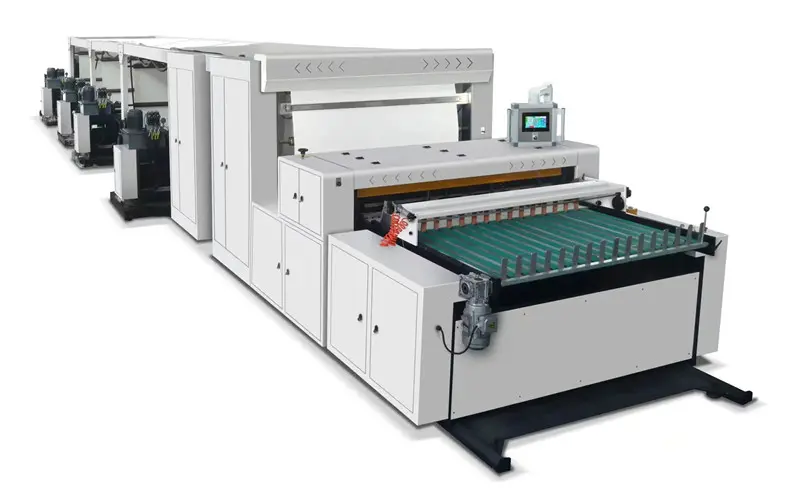
These published figures are not simultaneous performance guarantees. Confirm the permitted number of webs and total cutting load for your material; six unwinding positions do not establish that six webs can run at the maximum listed grammage.
Ask SAGLIN what the stated ±0.3 mm precision covers and under which material, format and operating conditions it is measured. Do not assume it also specifies squareness or print-to-cut accuracy. Agree on a sample trial and assess the results against your acceptance criteria. Confirm print-to-cut capability separately if required.
For broader equipment-selection considerations, see our guide to choosing roll-cutting equipment.
8. Frequently Asked Questions
The questions converters ask most before ordering food wrapping paper equipment:
Is greaseproof paper the same as PE-coated paper?
No. Greaseproof describes resistance to grease; PE-coated identifies a polyethylene coating. Confirm the material structure with the supplier instead of treating the names as interchangeable.
Do I need slitting/rewinding or roll-to-sheet cutting?
Choose according to the output. Slitting/rewinding produces narrower rolls. Roll-to-sheet equipment cross-cuts the web into sheets and may also slit it to the required widths.
What information should I send before requesting a quotation?
Send the paper type, grammage, coating details, roll width, diameter and core size, finished sheet dimensions, plain or printed status, tolerances and required output. Representative samples help assess suitability.
Planning a food wrapping paper cutting job?
Send your material specification, target sheet sizes and production requirements, and get a configuration review plus a material trial before deciding.
Request Configuration Review
