
Slitter Rewinder vs Sheeter: 7 Cutting Problems and How to Fix Them
Understand the two converting processes, diagnose the seven most common cutting problems, and plan material selection and investment.
Wrinkles, burrs and dimensional drift reduce qualified output even when the equipment reaches its rated cadence. This guide connects the converting process and acceptance criteria to seven practical diagnostic checks, then explains material selection and the investment calculation. Start with evidence from samples and production records, not a generic catalog.
1. Start with the required output
Choose the process before comparing machine speeds. Narrow rolls for a downstream press or bag line require rewinding. Flat wrapping sheets or printing stock require sheeting. Existing sheets needing final trimming usually require a guillotine.
Draw the material path from incoming stock to the next operation. Include core size, winding direction or stack requirements. A machine that cuts the right dimensions but delivers the wrong format adds handling and another converting step.

2. Compare the two converting processes
Slitter rewinder · roll-to-roll
- Parent roll
- Longitudinal slitting
- Rewinding
- Narrow rolls
Sheeter · roll-to-sheet
- Parent roll
- Web feed / optional longitudinal slit
- Cross-cut
- Stacked sheets
| Equipment | Input | Output | Selection focus |
|---|---|---|---|
| Slitter rewinder | Parent roll | Narrower wound rolls | Slit width, roll build and winding quality |
| Sheeter | Continuous web from rolls | Flat sheets | Sheet length, width, squareness and stacking |
| Guillotine | Pre-existing sheets or stacks | Trimmed sheets | Cut size, stack height and handling |
Specify acceptance limits for your job; these process categories do not imply standard tolerances.
Roll cutter is an ambiguous commercial name, not a synonym for slitter rewinder. Ask whether the quoted machine rewinds or cross-cuts into sheets. Rotary cutting describes a cutting mechanism; it does not automatically provide complex-shape die-cutting, which requires appropriate tooling and a suitable process.
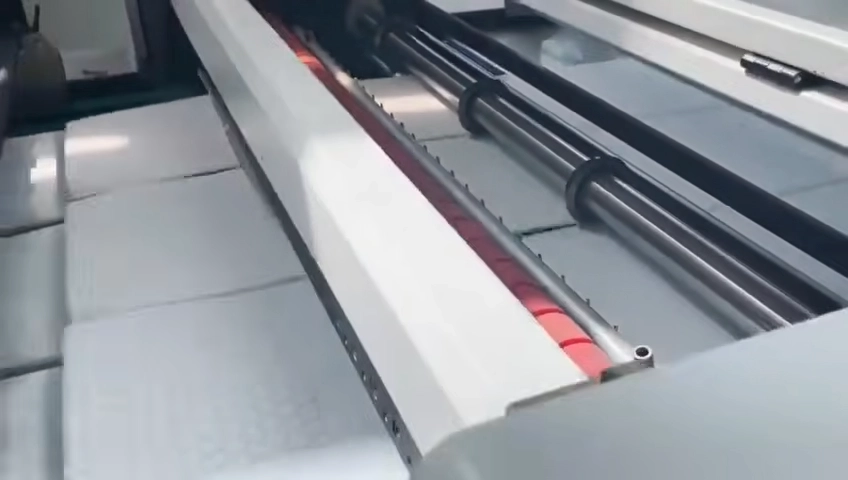
3. Blades, tension, EPC and four acceptance checks
Blade condition
Match blade geometry, material, clearance and overlap to the stock. Inspect wear and edge quality; no single hardness range suits every application.
Web tension
Set tension for stable transport without stretching or wrinkling. Taper may be used in rewinding; it is not a universal unwinder setting.
Edge guiding (EPC)
EPC corrects lateral web position. It cannot alone guarantee slit width or printed register; knife positioning, feed control and registration sensing also matter.
Accept length accuracy, width, squareness and print-to-cut registration separately. Agree measuring tools, sample quantities, conditioning and operating speeds. Check samples at startup and during the run, including after roll changes.
Before inspecting knives, clearing jams or adjusting guarded components, stop and isolate the machine according to the manufacturer’s procedures. Never reach into a moving web path.
4. Test actual materials before selection
Grease-resistant paper is not necessarily PE-coated. Papers may use different barriers, coatings or laminates. Supply the actual formulation, layer construction, base-paper grammage and total grammage rather than assuming all food-wrapping stock behaves alike.
Trial representative rolls for curl, friction, blocking, dust, coating damage and cut-edge quality. Determine tension experimentally within the manufacturer’s limits: lowering it is not always the answer, and delamination is not inevitable. Record acceptable settings for each tested construction.
For downstream cup converting, review integrated production lines separately; successful sheeting alone does not qualify the later forming process.
5. Troubleshooting quick reference
Use these as investigation starting points, not confirmed root causes. Compare retained samples and recorded settings before changing one variable at a time.
Before inspecting knives, clearing jams or accessing or adjusting guarded components, stop and isolate the machine according to the manufacturer’s procedures. Never inspect hazardous components or reach into the web path while the machine is moving.
| Symptom | Possible causes | Check first | Action direction |
|---|---|---|---|
| Ragged edges / paper dust | Blade wear, unsuitable clearance or material variation. | Compare cut-edge samples and material records; inspect blades only after stopping and isolating. | Service or set the knives to the manufacturer’s procedure, then trial representative stock. |
| Width variation | Knife position, lateral web movement or inconsistent measurement. | Check width at agreed sample positions; compare setup records and EPC indications from the operator interface. | After safe isolation, verify knife spacing; confirm guiding and repeat the width test. See what EPC guarantees. |
| Length variation — sheets only | Feed slip (encoder / timing belt), unstable tension or cross-cut timing. | Compare measured lengths with feed settings and recorded tension; use normal operator displays. | Have qualified personnel verify feed and cut controls under the manufacturer’s procedure; retest length. |
| Squareness / print-mark offset | Squareness: web alignment or cut geometry. Print offset: mark sensing, repeat length or cut timing. | Measure squareness separately from image-to-cut distance; compare mark-reading records. | Verify alignment for squareness and sensing/timing for print registration separately; EPC alone is insufficient. See why EPC alone is not enough. |
| Rewinding defects — rolls only | Unsuitable winding tension, core condition or roll alignment. | Examine finished rolls after safe removal; compare winding settings and core specifications. | Trial winding settings within the manufacturer’s limits; correct core or alignment issues after isolation. See the slitter vs sheeter difference. |
| Skewed stacks — sheets only | Sheet curl, delivery alignment or stacking settings. | Inspect safely removed stacks and material curl; compare delivery settings. | Check delivery and stack alignment after isolation; trial suitable settings and verify stack quality. See whether the HKS-1400 outputs sheets. |
| Wrinkles / creasing | Incorrect web tension, misaligned rollers or material/moisture variation. | Inspect safely removed samples; compare tension settings, roller alignment and material records. | Trial tension within the manufacturer’s limits; correct roller alignment after isolation and repeat the trial. |
6. Purchasing specification and HKS-1400
Send suppliers a job sheet rather than only a material name or headline speed:
- Output: narrow rolls or flat sheets, finished width and sheet length, core dimensions or stack format.
- Parent rolls: web width, maximum diameter, roll weight, core size and loading method.
- Material: base paper, coating or laminate construction, thickness, individual grammage and total combined grammage when feeding multiple webs.
- Acceptance: separate dimensional tolerances, edge quality and, for printed stock, repeat length and print registration requirements.
- Saleable output: accepted production per shift, waste allowance, changeover frequency, stack height and unloading or packing capacity.
Compare quotations on the same material and finished format. Allow for trim loss, roll changes, blade maintenance and downstream handling. Rated speed alone does not establish qualified output.
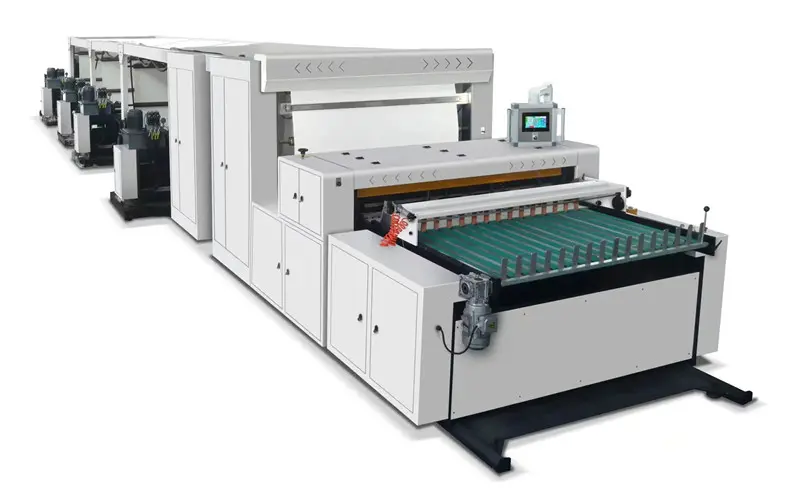
HKS-1400: an option for flat sheets
Consider the HKS-1400 automatic roll cutter only when the required output is flat sheets. It is a roll-to-sheet option, not a slitter rewinder for producing narrow finished rolls.
| Specification | Listed value | Confirm before ordering |
|---|---|---|
| Working width | 1400 mm | Usable layout and trim allowance |
| Unwinding | 6 stations | Roll limits and combined material loading |
| Operating cadence | 40–160 cycles/min | Actual rate depends on material and cut length |
| Cutting | Longitudinal circular knives and cross-cutting | Finished sizes and edge quality on samples |
| Listed accuracy | ±0.3 mm | Measured dimension, material, speed and test conditions |
Six unwinding stations do not mean maximum grammage can run at full load on every station simultaneously.
Do not convert cycles/min directly into sheets/min without an agreed production layout. The listed accuracy does not establish squareness or printed registration. Specify these independently and verify stacking at the intended production rate.
HKS-1400 · Roll-to-Sheet Cutting
- Check the material, format and combined loading limits.
- Agree a sample-based acceptance plan before purchase.
7. Investment, qualified output, payback and ROI
Budget the installed operation, not just the machine. Beyond the equipment, include knives, unwinding, handling, energy, setup and maintenance. Obtain itemized quotations and local cost estimates; do not assume utilities or commissioning are included.
Qualified output = speed × planned minutes × operating rate × quality yield. Use pcs/min or sheets/min; define operating rate as running time divided by planned time, and quality yield as accepted pieces divided by total produced. Validate these rates with trials and production records; nominal speed is not guaranteed shift output.
Payback (months) = total investment / monthly net cash flow. This simple estimate assumes positive, representative monthly net cash flow after recurring cash costs. If cash flow varies, use cumulative cash flow; zero or negative cash flow does not provide a finite payback under this formula.
ROI for a stated period = net profit during that period / total investment (multiply by 100 for a percentage). State the period and profit basis explicitly. Profit is not the same as cash flow. Include rejects, downtime, knives, energy, labor and maintenance in the appropriate calculation; no payback time or return is guaranteed.
8. Frequently asked questions
What is the difference between a slitter rewinder and a sheeter?
A slitter rewinder makes narrower wound rolls. A sheeter cross-cuts a continuous web into flat sheets. Choose by the output required downstream.
Does roll cutter mean slitter rewinder?
No. Roll cutter is a commercial label used for different processes. Confirm whether the machine delivers rewound rolls or cut sheets.
Does EPC guarantee cutting accuracy?
No. EPC guides lateral web position. Verify width, length, squareness and print registration separately under agreed material and speed conditions.
Is the HKS-1400 suitable for making narrow finished rolls?
No. The HKS-1400 is a roll-to-sheet cutting option. For narrow finished rolls, specify a slitter rewinder with suitable winding and roll-handling capacity.
Can coated paper run with the same settings as plain paper?
Do not assume so. Test the actual coating or laminate construction and total grammage, then establish suitable tension, blade settings and acceptance criteria.
For a configuration review, contact SAGLIN with your job sheet and representative material details. Confirm trial arrangements, service scope and spare-parts terms in the proposal.
Narrow rolls or flat sheets: what do you need?
Share your material, roll dimensions, finished format and acceptance criteria to discuss a suitable configuration.
Discuss Your Converting Process
