
Die Cutting and Creasing: 5 Stripping Failures and How to Automate
Slow or incomplete waste stripping after die cutting adds labor, delays changeovers and creates scrap. See the 5 failures and how the HTQF-1020 automates the process.
Die cutting and creasing cuts the outline and scores the fold lines of a carton. But the line does not end at the cut: after it comes waste stripping, and only then stacking and delivery to the folder-gluer. A press that cuts well can still lose the race at the stripping stage.
1. The process: from die cutting to waste stripping
Die cutting and creasing is the converting step that cuts the outline and scores the fold lines of a carton — pharmaceutical boxes, cigarette packs, cosmetics boxes, and paper cup and bowl blanks. But the line does not end at the cut: after it comes waste stripping — removing the internal and external scrap — and only then stacking and delivery to the folder-gluer. A press that cuts perfectly can still lose the race at this stage.
2. The 5 stripping failures
The five most common stripping failures — and how to diagnose each one. Keep defective samples, note the batch and settings, and locate the first station where the defect appears before any adjustment.
| Symptom | Likely cause | First check | Correction |
|---|---|---|---|
| Waste that won’t release | Waste ties (nicks) cut too wide | Measure the tie width on the die | Re-engrave the die with 0.5–1.0 mm ties |
| Partial separation | Irregular cutting depth | Check cut depth on the sheet | Calibrate pressure and cutting depth |
| Waste jamming | Flexible waste matrix or pins too far apart | Locate the jam point | Add or re-position stripping pins |
| Blank tearing | Excessive stripping force | Check stripping pin height | Lower the pin height |
| Waste reaching the gluer | Incomplete stripping before stacking | Inspect the stripping output | Adjust registration and stripping |
The causes above are possible, not confirmed: start with the fastest check and adjust one variable at a time.
3. How to automate with the HTQF-1020
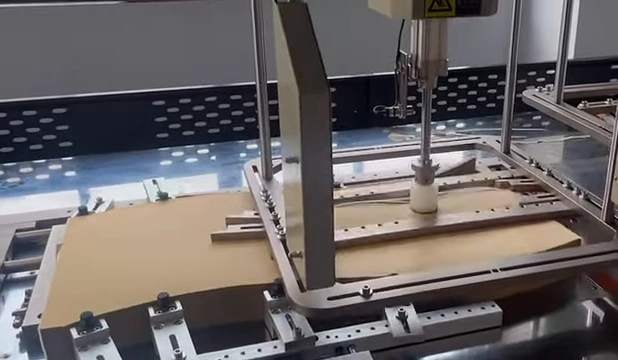
Automation turns stripping into a controlled, repeatable process. The HTQF-1020 automatic stripping machine is built for exactly this job: it accepts paper from 500 × 500 mm up to 1,100 × 920 mm, with a blanking area up to 380 × 920 mm, at 5–10 cycles per minute. Its integrated single-row blanking system supports multi-up production — and it is designed for the products that make manual stripping hardest: pharmaceutical packaging, cigarette packs, cosmetics boxes, and paper cup and bowl blanks.

When comparing machines, ask five things: which carton features create the hardest stripping areas? How often do operators stop to clear scrap or separate blanks? Can the machine handle current and planned sizes? How fast is tooling changeover between jobs? Does stripping protect print quality and crease accuracy?
4. Frequently asked questions about waste stripping
The questions we hear most from converters evaluating stripping automation:
Why evaluate stripping separately from cutting quality?
A press can cut well while the process still loses productivity after the cut. If waste stays attached, blanks are hard to separate or stacks become unstable, the operator steps in by hand — which adds labor and lowers the real output of the line.
What are the signs that stripping has become a bottleneck?
Operators stopping to knock out scrap, repeated jams after stripping, blanks reaching the folder-gluer with waste still attached, and slow changeovers on complex cartons — small windows, tight corners and hang holes are the ones that most expose the problem.
How does automation improve waste stripping?
With controlled feeding, accurate registration, vacuum or robotic waste removal, automated stacking and faster tooling changes. These upgrades reduce manual touches and make waste removal consistent across runs.
What should I review before buying a stripping machine?
Map the full process from feeding through delivery, and track where scrap stays attached, where jams happen and where operators add manual work. That shows whether the best investment is better registration, automated stripping or a broader upgrade.
Before investing, map your line from feeding through delivery. For most converters, the strongest return comes from stabilizing the steps after the cut — clean stripping, reliable stacking and fewer stoppages. SAGLIN Machinery designs packaging-forming equipment for the Brazilian production reality — send your material and volume for a technical evaluation.
Ready to automate waste stripping?
Get a technical evaluation of your die cutting process and a quote for the HTQF-1020 for your production mix.
Request Technical Evaluation
